
The unit prices behind the estimate
Our TikTok API prices are listed by operation. A profile lookup, a video-listing page and a comment page are distinct requests, even when they contribute to the same customer-facing feature. The table lets you price only the collections your application actually calls.
These values come from the pricing catalog used by this page. The 1,000-request column is the unit price multiplied by 1,000; it is not a promise of a fixed number of returned videos or comments. Use the request unit as the starting point, then count the pages your feature plans to collect.
| Operation | USD / request | USD / 1,000 requests |
|---|---|---|
| TikTok Creator Profile API | $0.002444 | $2.4440 |
| TikTok Profile Videos API | $0.002444 | $2.4440 |
| TikTok Video Comments API | $0.002444 | $2.4440 |
| TikTok Video Transcript API | $0.073320 | $73.3200 |
Calculate a 50-account daily tracker
Here is the plan behind the opening figure: 50 profile lookups each day and two video pages per account, giving 100 listing requests a day. Across 30 days, that is 1,500 profile requests and 3,000 video-page requests. The calculation below applies our catalog price to each operation.
daily_cost = 50 * profile_price
           + 50 * 2 * video_page_price

30_day_cost = daily_cost * 30
Example API collection subtotal
| Operation | Requests | Subtotal |
|---|---|---|
| TikTok Creator Profile API | 1,500 | $3.666 |
| TikTok Profile Videos API | 3,000 | $7.332 |
| Total | $10.998 | |
The page cap makes this an explicit plan rather than a guess about every account’s history. Stop earlier when an account has no next page. If some accounts need a deeper scan, budget those additional pages separately instead of silently increasing the allowance for the whole tracker.
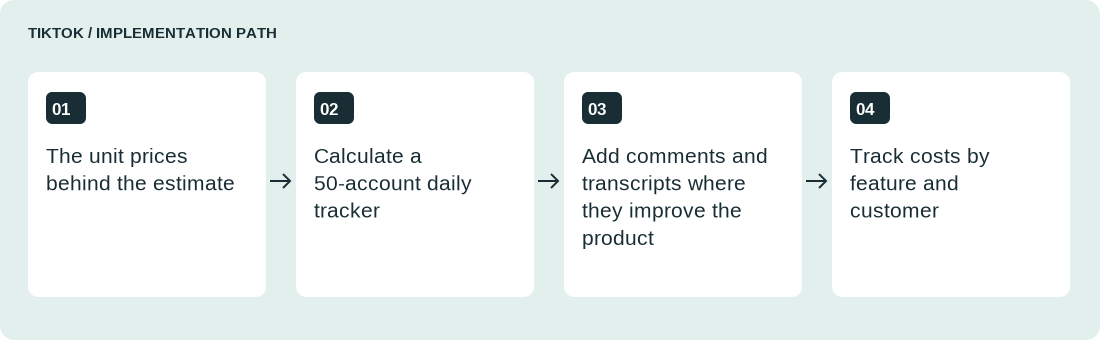
Add comments and transcripts where they improve the product
If you select ten videos and allow three comment pages for each, budget up to 30 comment-page requests. Reading replies adds its own operation. Count that work separately from the video-listing pages that found the sources.
A transcript can power a summary or search feature, but you may only need text for a subset of videos. Use the video records to choose those sources, collect their text with our API and reuse stored transcripts for later questions when your refresh policy allows it.
Track costs by feature and customer
Record each request’s operation, customer and run ID. Then a scheduled account refresh and an on-demand summary appear as separate feature costs, even when they use the same API key. This gives you a basis for setting customer allowances around actual usage.
| Cost to track | Example activity | Budget it as |
|---|---|---|
| Profile enrichment | Known account lookups | Count × profile price |
| Content tracking | First and follow-up video pages | Pages × listing price |
| Feedback research | Comments and selected replies | Each operation separately |
| AI summaries | Transcript plus your model call | Collection and model costs separately |
Keep the API subtotal distinct from storage, hosting and model usage. Our API supplies the collected data; the rest of your product still has its own costs. That distinction makes a per-user price easier to maintain as people use different features.
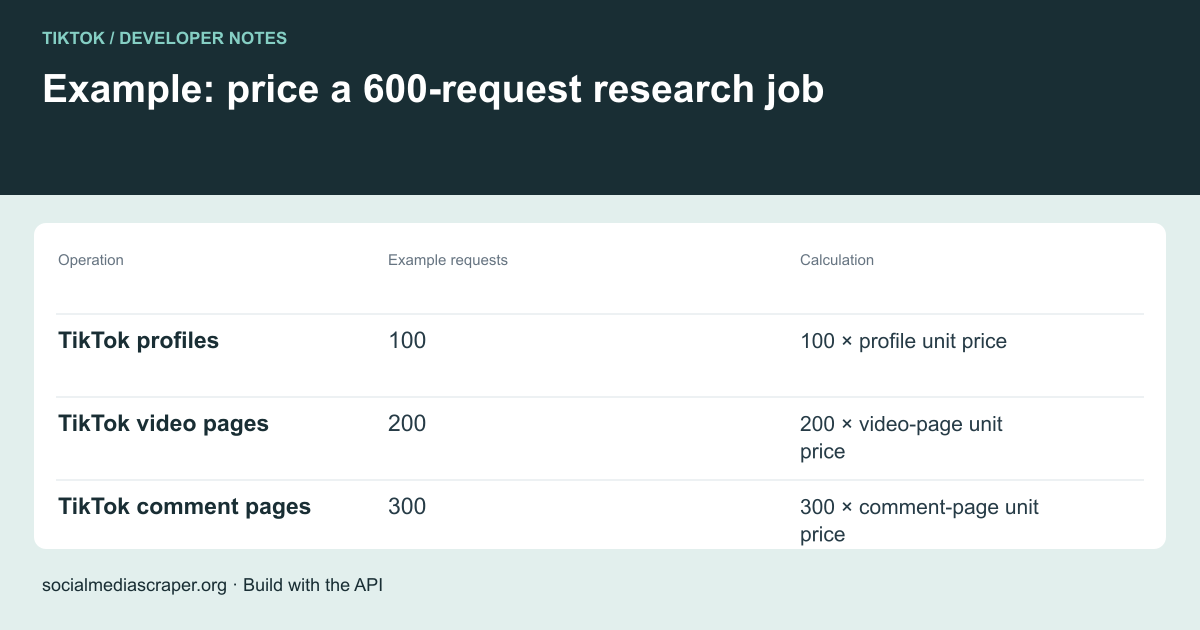
Example: price a 600-request research job
For a one-off research job, suppose you need 100 profile lookups, 200 video pages and 300 comment pages. Add the three operation subtotals shown below. A total of 600 requests only becomes a useful cost estimate after those requests are assigned to their operation prices.
Example API collection subtotal
| Operation | Requests | Subtotal |
|---|---|---|
| TikTok Creator Profile API | 100 | $0.2444 |
| TikTok Profile Videos API | 200 | $0.4888 |
| TikTok Video Comments API | 300 | $0.7332 |
| Total | $1.4664 | |
For your own estimate, replace the counts with the account volume, page depth and selected videos your application expects. Start with a small run to learn those volumes, then use the same calculation to set a predictable allowance.
| Operation | Example requests | Calculation |
|---|---|---|
| TikTok profiles | 100 | 100 × profile unit price |
| TikTok video pages | 200 | 200 × video-page unit price |
| TikTok comment pages | 300 | 300 × comment-page unit price |
Use a small collection to set a realistic allowance
Start with a few accounts and record how many video and comment pages your feature uses. Compare that observation with the page caps in your plan. Keep new requests separate from retries, and preserve the request identity when following our documented status or replay flow.
Use the pricing page to set your initial budget, then create an API key and run the TikTok operations your feature needs. Add model generation, storage and hosting separately when estimating the complete product cost. The figures in this article are the collection subtotal, not the price of running the entire application.
FAQ
Common questions
A few details to check before you build.
Is the cost based on requests or returned comments?
This estimate uses API operation request prices. One comment-page request can contain multiple rows, so count pages and check the operation quote rather than multiplying by individual comments.
Does a profile request include video and comment collection?
No. Profiles, video pages, comments and transcripts are separate operations. Include only the ones your product calls and calculate their subtotals individually.
Can I calculate the price before a larger run?
Yes. Estimate counts for each operation, multiply by the published unit price and add the results. Page caps can give you an upper bound for a planned collection.
Are AI model costs included in these examples?
No. These examples calculate the API collection subtotal. Add your own model, storage and hosting costs separately when pricing the complete feature.
API references, tutorials and sources

socialmediascraper.org team
API guides and practical examples by the socialmediascraper.org team.