
Define what makes a creator relevant
Suppose your product helps users find camping-equipment creators. “Has 10,000 followers” describes account size; “reviewed a sleeping bag last month” explains relevance. Build the list around both: a profile for the account card and a post that shows why the creator belongs in the results.
Begin with handles submitted by a user or imported from an existing list. A profile lookup enriches a known account; it does not search all of Instagram for creators in a category. Once you have those handles, our profile and post endpoints provide the two collections needed for this shortlist.
| Part of the list | Fields to keep | What it enables |
|---|---|---|
| Creator | Account ID, handle, profile URL | One account record across updates |
| Profile snapshot | Biography, available metrics, collection time | Filters and a readable creator card |
| Matching content | Post ID, text, URL | An explanation for each recommendation |
1. Fetch the account details
Call instagram.profile with one handle and check that data.handle matches the account you intended to review. Save data.id as the account key, then use the name, biography, profile URL and available follower count to populate the creator card. Keep the source handle as well, so a reviewer can recognize the account.
Set SOCIALSCRAPER_API_KEY on your backend and replace the example input with your source.
// Instagram Profile API · instagram API
const response = await fetch("https://socialmediascraper.org/v1/instagram/profile?handle=jane", {
  method: 'GET',
  headers: {
    'x-api-key': process.env.SOCIALSCRAPER_API_KEY,
    'x-price-version': '2026-11-23.retail-1',
    'Idempotency-Key': crypto.randomUUID()
  }
});

if (!response.ok) throw new Error(`HTTP ${response.status}: ${await response.text()}`);
const data = await response.json();
console.log(data);
Store missing metrics as null rather than zero. This keeps an incomplete response from looking like a zero-follower account. Save the collection time too, so your review screen can show when the profile was checked.
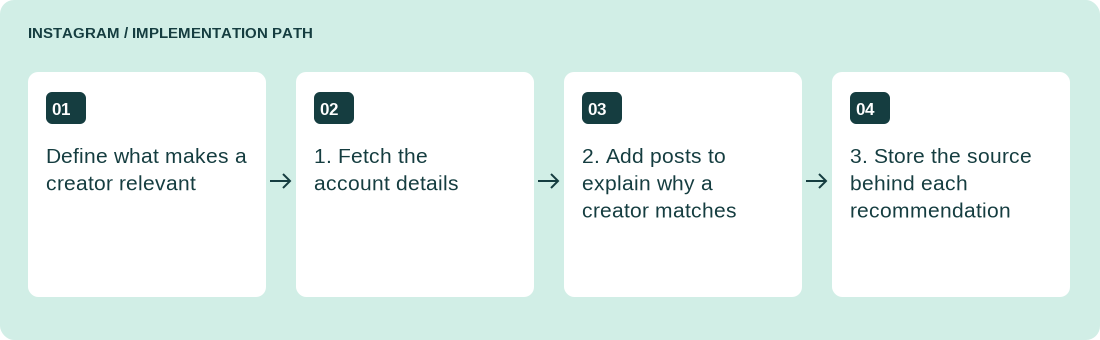
2. Add posts to explain why a creator matches
For each saved account, call instagram.posts and inspect the returned text, publication dates and URLs. Your application can flag posts mentioning “tent” or “sleeping bag,” then apply the time window you chose. Keep each matching post and a short reason, such as “mentions sleeping bags in the reviewed sample.”
Set SOCIALSCRAPER_API_KEY on your backend and replace the example input with your source.
// Instagram Profile Posts API · instagram API
const response = await fetch("https://socialmediascraper.org/v1/instagram/posts?handle=example", {
  method: 'GET',
  headers: {
    'x-api-key': process.env.SOCIALSCRAPER_API_KEY,
    'x-price-version': '2026-11-23.retail-1',
    'Idempotency-Key': crypto.randomUUID()
  }
});

if (!response.ok) throw new Error(`HTTP ${response.status}: ${await response.text()}`);
const data = await response.json();
console.log(data);
Add instagram.reels when your product also reviews Reels. Fetch comments for selected content when audience questions matter. These operations are available in our catalog, so you can expand the product without starting a new provider integration for every collection.
3. Store the source behind each recommendation
Store the link between the account, the post and the reason it matched. The SQL below is an application-side schema: it saves the post ID, original text, source URL and review reason. These extra review fields are created by your app rather than returned as API-generated recommendations.
CREATE TABLE creator_evidence (
  account_id TEXT NOT NULL,
  post_id TEXT NOT NULL,
  source_url TEXT NOT NULL,
  original_text TEXT NOT NULL,
  match_reason TEXT NOT NULL,
  collected_at TEXT NOT NULL,
  PRIMARY KEY (account_id, post_id)
);
A reviewer should be able to open the source post from a shortlist row. Keeping the original text also lets you change the keyword rule or rerun a classifier over the saved sample. You can improve the ranking before deciding whether you need another collection pass.
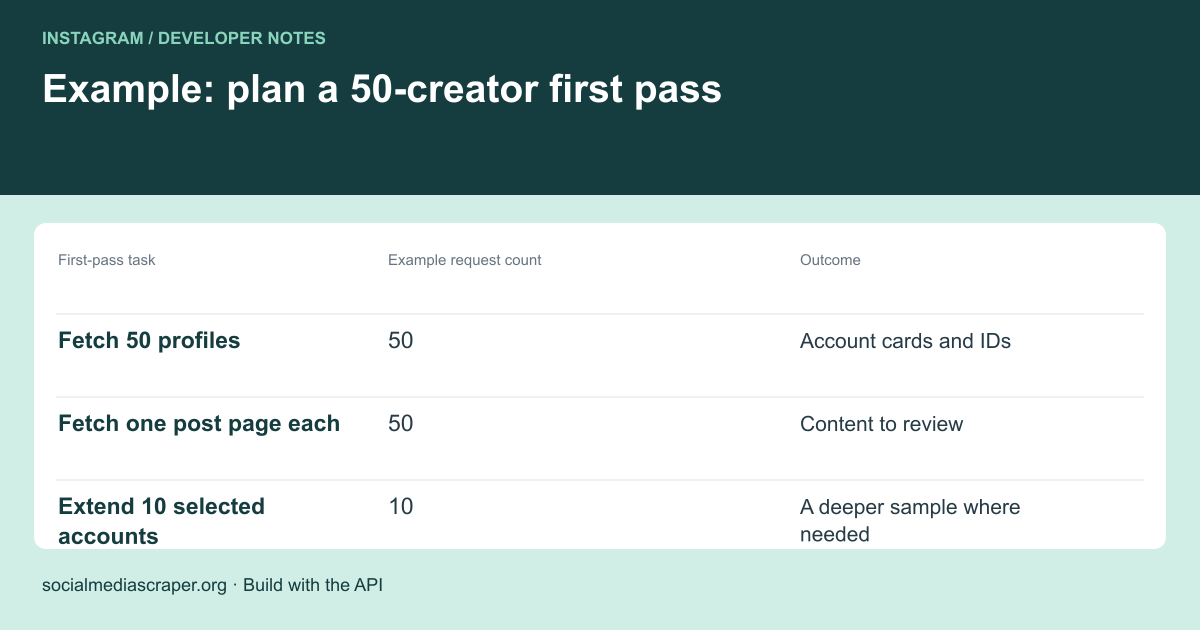
Example: plan a 50-creator first pass
For 50 known handles, one profile request and one first post page per account means 100 new requests. If ten accounts need one more post page, the total becomes 110. You can estimate the first pass from the operation prices before deciding which accounts deserve deeper collection.
Returned sample sizes can differ. If one account gives you 12 posts and another gives you four, save those counts beside the result. Show topic matches through their source posts; compare engagement only after deciding on a comparable sample.
| First-pass task | Example request count | Outcome |
|---|---|---|
| Fetch 50 profiles | 50 | Account cards and IDs |
| Fetch one post page each | 50 | Content to review |
| Extend 10 selected accounts | 10 | A deeper sample where needed |
Refresh the list without duplicating creators
Use the returned account ID to update a creator who changes their handle. Store posts under their own IDs and keep new metric observations separate if the product needs a history chart. This preserves the original evidence while allowing the account card to show current information.
The first version can be a handle upload, one profile lookup and one post page per account, followed by a reviewable list. Add Reels or selected comments when they answer a new product question. Start with our Instagram Profile API, then connect the Posts API to add the content behind each result.
FAQ
Common questions
A few details to check before you build.
Does socialmediascraper.org find creators from a category name?
The profile operation enriches a known account handle. Start from a user’s handles, an imported list or a separate discovery step, then use profile and content data to decide which accounts fit your category.
Can I add Reels and comments to the shortlist?
Yes. Use the corresponding Instagram Reels and comments operations for the content you select. Keep IDs and source links when combining their results with your creator records.
How should I rank the creators?
Use available profile metrics to narrow the range, then rank content against a stated rule. For example, count relevant posts in the reviewed period and show one supporting URL. The ranking is your application’s decision, backed by records collected through our API.
Can the list be updated automatically?
Your scheduler can call the same operations for saved accounts. Update by account ID, deduplicate posts and keep collection dates so repeated runs do not create duplicate creators.
API references, tutorials and sources

socialmediascraper.org team
API guides and practical examples by the socialmediascraper.org team.